Divorce Settlement Calculator: How to Evaluate Your Options

Divorce Settlement Calculator: How to Evaluate Your Options

When people search for a divorce settlement calculator, they are usually trying to understand what different settlement options would mean financially. They are often trying to answer a much bigger question: What would different settlement options actually mean financially?

That question is understandable. Divorce settlements can involve many assets, debts, income, retirement accounts, taxes, and future obligations that are not always easy to compare by simple dollar value alone.

While the word ‘calculator’ suggests a simple answer, divorce settlement outcomes are rarely that straightforward. Evaluating a divorce settlement usually requires more than basic arithmetic. It often requires comparing multiple possible outcomes and understanding how each one may affect your financial future.

Approaching settlement decisions this way can help bring important financial factors into view for careful consideration before any agreement becomes final.

Working with an attorney on the divorce financial settlement

In this guide you’ll learn:

  • What people usually mean when they search for a divorce settlement calculator
  • Why divorce settlements often require more than simple math
  • Which financial factors can change the true outcome of a proposal
  • How to compare different settlement options more clearly before making decisions

What a Divorce Settlement Calculator Is Really Trying to Do

Most people looking for a divorce settlement calculator are not simply searching for a number. They are trying to understand how different ways of dividing assets and debts may affect their financial future.

In some cases, they may want to compare a proposed 50/50 split to other possible arrangements. In other cases, they may want to see what happens if one person keeps the house, assumes more debt, or receives more of one type of asset than another.

The underlying goal is usually the same: to better understand the financial implications of possible settlement outcomes before agreeing to them.

A divorce settlement calculator is rarely just about calculating numbers. It is really about comparing outcomes and understanding what different settlement choices may mean financially.

Why Simple Math Is Often Not Enough

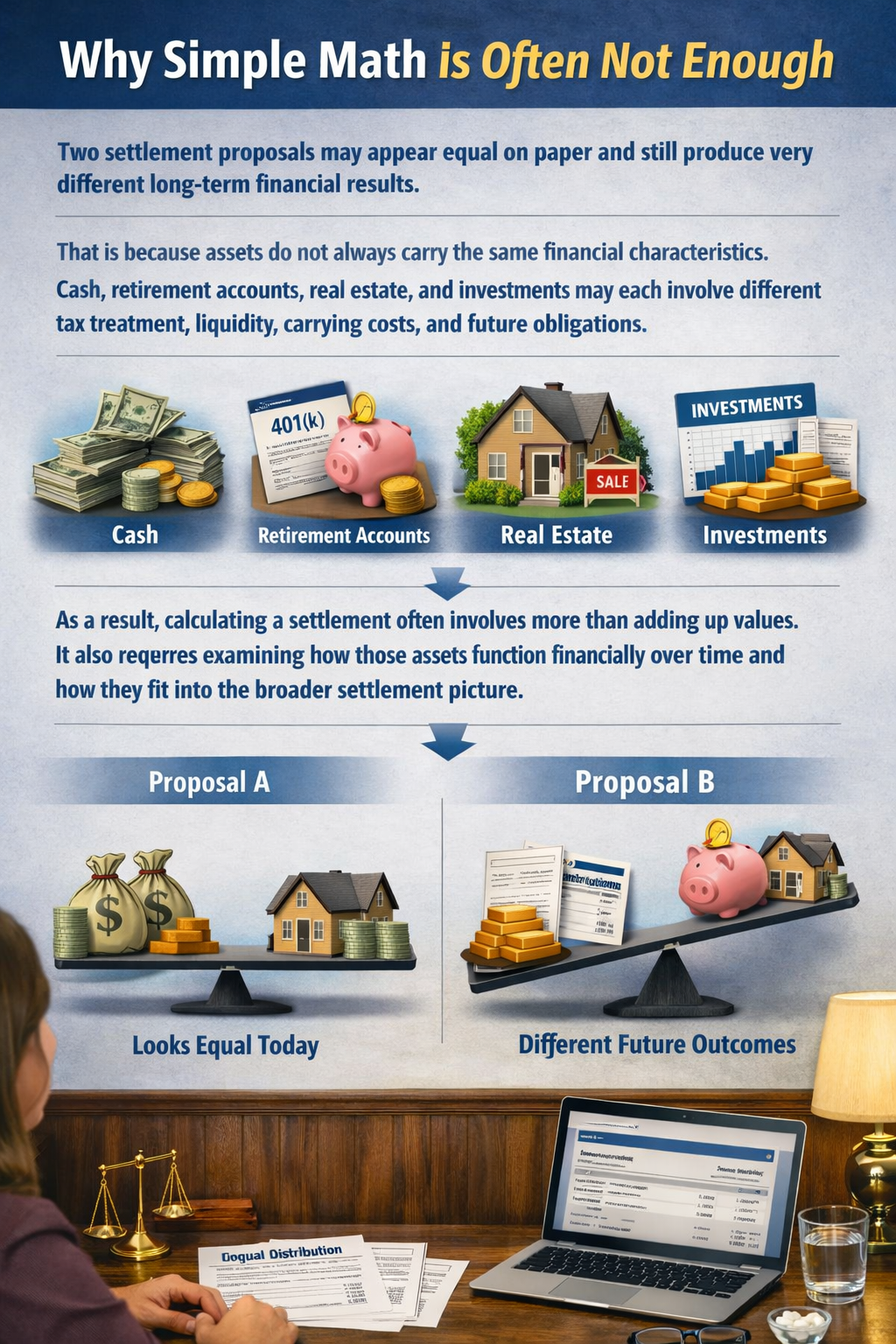
Two settlement proposals may appear equal on paper and still produce very different long-term financial results.

That is because assets do not always carry the same financial characteristics, and those characteristics can change differently for different assets over time. Cash, retirement accounts, real estate, and investments may each involve different tax treatment, liquidity, carrying costs, and future obligations.

As a result, calculating a settlement often involves more than adding up values. It also requires examining how those assets function financially over time and how they fit into the broader settlement picture.

For example, one proposal might involve receiving $100,000 in retirement funds, while another offers $100,000 in cash. While the values appear equal, taxes, future value and access to funds may make the outcomes very different.

The many reasons why simple math doesn't work in divorce settlements

The Financial Factors That Can Change the Outcome

Several financial elements can significantly affect whether a proposed settlement works well in practice.

Asset Type

Not all assets are equally useful, accessible, or flexible. The type of asset received can matter as much as the stated value.

Debt Allocation

Who assumes particular debts can strongly affect future cash flow, refinancing options, and borrowing capacity.

Tax Consequences

Some assets may carry future tax obligations that change their real financial value.

Liquidity

Receiving value in illiquid assets may create a different financial reality than receiving cash or easily accessible funds.

Future Costs

Assets like a home may also involve ongoing expenses that continue long after the settlement is complete.

Why Comparing Different Settlement Options Matters

One proposed settlement may seem reasonable in the moment, but without comparing alternatives it can be difficult to understand whether it truly supports your longer-term financial position or not.

For example, one scenario may involve keeping the family home while another may involve selling it and retaining greater liquidity. One proposal may shift more debt to one spouse, while another balances assets differently but changes future obligations.

Comparing these possibilities can help reveal trade-offs, risks, and opportunities that might otherwise remain hidden.

A proposal that appears fair at first glance may look very different once taxes, debt obligations, and future costs are taken into account.

What to Look for in a Divorce Settlement Calculator

When evaluating a divorce settlement calculator or analysis tool, it can be helpful to look beyond whether it simply produces a number.

A more useful tool should help organize financial information, compare different settlement structures, and bring important financial considerations into view before decisions are finalized. A tool that only produces a single number may not provide enough insight to support meaningful decisions.

It should also make it easier to update values, test alternative allocations, and evaluate the practical implications of proposed outcomes as negotiations change over time.

How DivorceSplit Helps You Evaluate Settlement Options

DivorceSplit was created to help individuals analyze settlement scenarios and compare how different proposals may affect their financial position.

By organizing financial information and allowing users to model different allocations of assets and debts, DivorceSplit helps bring financial consequences into view before agreements are finalized.

Users can update values, evaluate changing proposals, and compare how different arrangements may affect net worth, debt obligations, and overall financial outcomes.

Rather than relying only on assumptions or rough estimates, scenario analysis can help individuals approach settlement decisions with greater clarity and confidence.

If you are also weighing emotionally significant assets, you may find it helpful to read our guide on whether to keep the house in a divorce. You can also explore our article on financial mistakes to avoid in divorce settlements.

Finalizing the most favorable divorce settlement with DivorceSplit

Moving Forward With Greater Clarity

Searching for a divorce settlement calculator is often the beginning of a larger effort to understand what different settlement options may actually mean financially.

Because divorce settlements involve more than simple math, taking the time to compare multiple scenarios and evaluate the broader financial consequences can be an important step before making decisions.

Understanding these possibilities more clearly can help individuals approach settlement discussions with greater confidence and a better sense of what different outcomes may mean going forward.

Should You Keep the House in a Divorce?

Should You Keep the House in a Divorce?

One of the most common and difficult questions in divorce is whether you should keep the house. For many going through divorce, the family home is one of the most emotionally significant and financially important assets involved in the settlement.

Keeping the house may seem like the most stable or comforting option, especially when children, memories, or a desire for continuity are involved. But the financial consequences of keeping the home are not always obvious at first glance.

A decision that feels right emotionally may carry long-term financial obligations that affect future flexibility, debt capacity, and overall financial stability.

Understanding the full picture can help individuals evaluate whether keeping the house truly supports the outcome they want going forward.

Should I sell or keep the home?

In this guide you’ll learn:

  • Why keeping the house may not always be the safest financial choice
  • What ongoing costs and obligations can affect the real value of the home
  • How taxes, refinancing, and equity can change the long-term outcome
  • How to evaluate whether keeping the house supports your broader settlement goals

Keeping the house may feel like preserving stability, but the long-term financial impact can be very different from the emotional value it represents in the moment.

The Ongoing Costs of Keeping the House

Keeping the home usually means more than simply retaining the asset itself. It can also mean taking on continuing expenses such as mortgage payments, property taxes, insurance, maintenance, repairs, and utilities.

Even if the home appears valuable on paper, these ongoing costs can significantly affect monthly cash flow and future financial flexibility.

In some cases, the cost of maintaining the home may place strain on a person’s ability to manage debt, save for the future, or respond to unexpected expenses.

Mom taking a quiet moment to reflect on selling or keeping the home

Equity, Buyouts, and Refinancing Considerations

When one spouse keeps the family home, the other spouse may need to be compensated for their share of the equity. This can require a cash payment, the transfer of other assets, or an agreement tied to refinancing.

Refinancing may also be necessary to remove the other spouse from the mortgage or to make the ownership arrangement workable. These are critical steps taken to determine the equitable division of the house property, and must be made with caution and care, always keeping in mind the possible future consequences of each decision. For example, in some cases, because of such arrangements individuals may discover that they are unable to refinance or qualify for a new loan after the settlement, which can create unexpected financial pressure.

Before agreeing to keep the house, it can be important to evaluate whether refinancing is realistic, whether the debt load is sustainable, and how the arrangement affects overall net worth after the settlement.

Taxes and Future Sale Implications

A home may appear to represent a straightforward share of marital value, but future tax consequences can change how beneficial that asset really is.

If the home is sold later, capital gains, selling costs, and market conditions may affect the net financial outcome. What once seemed like a fair and balanced asset division may look very different down the road, once those future costs are considered.

Understanding how a future sale may affect the value of the home can help individuals assess whether keeping it supports their long-term financial goals or not.

A house may represent comfort and continuity, but in some settlement scenarios it can also concentrate future costs, risk, and tax exposure in a way that is easy to underestimate up front.

Why Comparing Alternatives Matters

One of the most important questions is not simply whether you can keep the house, but whether keeping it produces the financial outcome that works best for your situation. Many of these decisions are also tied to common financial mistakes people make during divorce settlements.

Comparing multiple settlement scenarios can help bring this into view. For example, one scenario may involve keeping the home and assuming more debt, while another may involve selling the home and preserving greater liquidity or flexibility.

Without comparing alternatives carefully, it can be difficult to understand whether keeping the house supports long-term financial stability or simply feels preferable in the short term.

How DivorceSplit Helps Evaluate Whether Keeping the House Makes Sense

DivorceSplit was created to help individuals analyze settlement scenarios and better understand how decisions about major assets may affect their financial future.

By organizing financial information and modeling different settlement outcomes, users can evaluate what happens when the house is retained, sold, offset by other assets, or combined with different debt assumptions.

This allows individuals to compare how each option may affect net worth, debt obligations, and overall financial position before agreeing to a settlement proposal.

Rather than relying only on emotion, assumptions, or rough estimates, scenario analysis can help bring the financial consequences of keeping (or letting go of) the house more clearly into view.

For a broader look at the financial issues that shape divorce outcomes, see our guide on what divorce may cost financially.

Meeting for the final settlement before court

Moving Forward With Greater Clarity

Keeping the house in a divorce may or may not be the right decision depending on the broader financial picture. A decision that feels good now, may result in expensive and burdensome consequences down the road.

What matters most is understanding how the home fits into the full settlement outcome — including cash flow, debt capacity, tax implications, and long-term financial flexibility.

Taking the time to compare possible scenarios can help individuals approach this decision with greater confidence and a clearer understanding of what the future may look like financially.

Financial Mistakes to Avoid in Divorce Settlements

Financial Mistakes to Avoid in Divorce Settlements

Divorce settlements involve many financial decisions, and the long-term consequences of those decisions are not always obvious at first glance.

Many people understandably focus on dividing assets as quickly and fairly as possible. However, certain financial details can significantly influence the outcome of a settlement over time.

Without carefully evaluating how assets, debts, taxes, and future obligations interact, individuals may unknowingly agree to arrangements that can adversely affect their financial position long after the divorce is finalized. In some cases, individuals may find themselves unable to refinance or qualify for new loans after the settlement if debt obligations are not carefully evaluated.

Understanding some of the most common financial pitfalls can help individuals approach settlement decisions more intentionally, and with greater clarity.

Contemplating the expense of divorce

In this guide you’ll learn:

  • The most common financial mistakes people make during divorce settlements

  • Why some agreements that appear fair may have hidden long-term unfair consequences

  • How taxes, asset types, and debt can affect your true financial outcome

  • How to evaluate settlement proposals more clearly before making decisions

Focusing Only on Asset Value Instead of True Financial Impact

At first glance, dividing assets based purely on their current dollar value may appear fair. However, different types of assets can carry very different financial consequences over time.

Cash, retirement accounts, real estate, and investment portfolios may all have different tax implications, liquidity considerations, and future obligations attached to them.

Evaluating the broader financial impact of these assets can help reveal differences that may not be obvious when looking only at their stated value.

Many divorce settlements that appear financially equal on paper can produce very different long-term outcomes once taxes, asset types, and future obligations are considered.

Overlooking the Tax Consequences in Divorce Settlements

Taxes can significantly influence the real value of many assets commonly included in divorce settlements.

For example, retirement accounts may involve tax implications upon withdrawal, while real estate transactions may generate capital gains penalties depending on future circumstances.

Understanding how taxes may affect certain assets can help individuals better evaluate the true financial outcome of different settlement proposals.

parting with the family home with attorney

Making Emotionally Driven Decisions About the Family Home

The family home often carries strong emotional significance. As a result, one spouse may wish to keep the property as part of the settlement.

However, maintaining a home can involve ongoing costs such as property taxes, maintenance, insurance, and mortgage obligations.

Considering the full financial implications of home ownership can help individuals determine whether retaining the property aligns with their long-term financial situation.

An asset that feels emotionally important today may create financial strain tomorrow if the long-term costs are not fully considered.

Accepting Settlement Proposals Without Comparing Alternatives

One of the most common challenges during divorce negotiations is evaluating settlement proposals in real time.

Without the ability to compare multiple possible settlement scenarios, it can be difficult to understand how different arrangements might affect financial outcomes.

Exploring alternative settlement structures can often reveal trade-offs or advantages that are not immediately apparent and may otherwise miss.

Why Scenario Analysis Can Help Avoid These Pitfalls

Because divorce settlements involve many interacting financial elements, evaluating only one proposed outcome may not provide a complete picture.

Scenario analysis allows individuals to explore how different allocations of assets and debts may influence financial results before agreements are finalized.

Understanding the full financial impact of divorce is critical — you can explore this in more detail in our guide on what divorce may cost financially.

This type of analysis can help clarify potential consequences and support more informed decision-making during negotiations.

How DivorceSplit Helps Evaluate Settlement Outcomes

Divorce is not a single moment in time. Financial circumstances, asset values, and settlement proposals often evolve throughout the process.

As negotiations progress, new information may emerge, asset values may change, or new proposals may be introduced by the other party. These changes can alter the financial implications of a potential settlement.

DivorceSplit was designed to help individuals evaluate these changes as they occur.

By organizing financial information in one place, users can update values, adjust allocations of assets or debts, and explore how different settlement proposals may influence their financial outcome, before any agreement is finalized.

This ability to revisit and refine settlement scenarios helps ensure that decisions are made using the most current financial picture available.

DivorceSplit also generates reports that provide a clear snapshot of a user’s financial position under a proposed settlement scenario.

These reports help illustrate how a particular proposal may affect overall net worth, debt obligations, and the balance of assets received in the settlement.

Understanding this financial position can be especially important when evaluating practical considerations such as refinancing a mortgage, carrying debt, or qualifying for future loans.

By providing an organized view of potential outcomes, DivorceSplit helps individuals approach settlement decisions with greater clarity and confidence. In addition, DivorceSplit provides you and your attorney with a series of reports and appendices for presentation in court, that clearly explain all the moving parts of your proposed settlement.

Divorcesplit builds a split scenario
Successful ruling with DivorceSplit
won the settlement

Divorce negotiations often evolve over time. The ability to update financial information and evaluate new settlement proposals can help reveal how those changes may affect long-term financial outcomes.

Moving Forward With Greater Financial Clarity

Divorce settlements involve complex financial considerations, and small differences in how assets and obligations are divided can significantly affect long-term outcomes.

Taking the time to evaluate potential scenarios and understand the financial consequences of different arrangements can help individuals approach settlement negotiations with greater clarity and confidence.

What Will Divorce Cost Me Financially? Understanding the Real Impact of Divorce Settlements

What Will Divorce Cost Me Financially?
Understanding the Real Impact of Divorce Settlements

For many people facing divorce, one of the first questions that arises is simple but deeply unsettling:

“What will divorce cost me financially?”

The answer is rarely straightforward.

Divorce settlements often involve a wide range of financial elements — assets, debts, income, property, retirement accounts, and taxes. Even small differences in how these elements are divided can significantly affect the financial outcome for each person.

A proposal that appears fair on the surface may look very different once the long-term financial consequences are considered more carefully.

Understanding how these financial factors interact is an important first step toward clearly evaluating possible settlement outcomes.

In this guide you’ll learn:

  • Why divorce costs are difficult to estimate
  • The financial factors that shape settlement outcomes
  • Why some agreements that look fair may not be
  • How to evaluate potential settlement scenarios

Why This Question Is So Difficult to Answer

Unlike many other financial decisions, divorce settlements do not have a simple formula that produces a single answer.

Every situation is different. The financial outcome of a divorce depends on a number of factors, including the types of assets involved, how those assets are divided, the treatment of debts, the tax implications of certain assets, and the future financial responsibilities each spouse may assume.

Two settlements with the same total dollar value may produce very different financial realities depending on the composition of the assets and liabilities, and the obligations attached to them.

For example, cash, retirement accounts, real estate, and investment portfolios can all carry different financial consequences over time. Evaluating these differences carefully can make a significant difference in understanding the real impact of a settlement.

The Biggest Financial Factors in Divorce

Several key financial elements often shape the outcome of a divorce settlement.

Assets and Property

Marital assets may include real estate, savings accounts, investment portfolios, vehicles, businesses, and other property accumulated during the marriage. The value of these assets is only part of the equation; how they are divided and who assumes responsibility for them can affect long-term financial stability.

Debt Allocation

Debt is often divided alongside assets. Mortgages, credit card balances, personal loans, and other financial obligations must be considered when evaluating the fairness of a settlement.

The Family Home

The family home is often one of the largest financial components of a divorce settlement. Decisions about whether one spouse keeps the home or whether it is sold can have lasting (and often hidden) financial implications, including maintenance costs, taxes, and future market conditions.

Retirement Accounts

Retirement savings can represent a significant portion of marital assets. However, these accounts often carry tax implications and withdrawal restrictions that affect their true financial value.

Taxes

Tax consequences can significantly influence or obscure the real value of certain assets. Without careful consideration, one spouse may unknowingly assume a greater tax burden in the future.

Legal and Professional Costs

Divorce proceedings often involve legal and professional expenses. Understanding how these costs affect overall financial outcomes can also be an important part of evaluating settlement proposals.

Why a Settlement That Looks Fair May Not Be Fair

Some settlement proposals may appear fair at first glance, or seem a generous offer from the other side, but reveal important financial differences when examined more closely.

Consider a situation in which one spouse keeps the family home while the other receives investment assets of similar value. On paper, the division may look balanced. However, the long-term financial implications could differ depending on maintenance costs, property taxes, market conditions, and potential future tax liabilities. Similarly with a cash-out. Often buying out one partner’s interest in the family home can result in a significantly unbalanced outcome if not carefully examined on the front end.

Without examining these factors carefully, it can be difficult to understand the true financial impact of a proposed settlement.

Evaluating different scenarios can help reveal how various settlement structures might affect each person’s financial future.

This type of analysis allows individuals to move beyond assumptions and gain a clearer understanding of how various settlement proposals may influence their financial position.

Why Scenario Analysis Matters

Because divorce settlements can involve many interacting financial elements, evaluating only a single proposed outcome may not provide a complete picture.

Exploring multiple settlement scenarios can help clarify how different arrangements may affect financial stability over time. Comparing possible outcomes can also help highlight trade-offs that may not be obvious at first glance.

This type of analysis allows individuals to move beyond assumptions and gain a clearer understanding of how various settlement proposals may influence their financial position. They can allow the comparison of one settlement to another, and enable tweaking of those important variables to fine-tune the best outcome.

How DivorceSplit Helps Bring Financial Consequences Into View

DivorceSplit was created to help individuals explore possible settlement outcomes and better understand how different financial decisions may affect them.

By entering information about assets, debts, income, and other financial elements, users can model different settlement scenarios and compare the potential results. DivorceSplit can take into account the many implications of each asset and how it’s allocated. This allows individuals to evaluate how various proposals might effect their financial situation, before agreements are finalized.

Rather than relying solely on estimates or assumptions, scenario analysis can help bring important, real-world financial considerations into view, making it easier to evaluate possible outcomes more confidently.

Common Financial Mistakes People Make in Divorce Settlements

Several common mistakes can affect financial outcomes during divorce settlements:

  • Focusing only on the face value of assets rather than their long-term financial implications
  • Overlooking potential tax consequences associated with certain assets
  • Undervaluing retirement accounts compared to cash or property
  • Using opinions or estimates rather than professional appraisals for asset valuation
  • Making emotionally driven decisions about assets such as the family home
  • Assessing the assets and overlooking liabilities
  • Accepting settlement proposals without evaluating alternative scenarios

Carefully examining these factors can help individuals better understand how different choices may affect their financial future.

Move Forward With Greater Financial Clarity

Divorce settlements involve many moving parts and financial considerations, and the long-term consequences of certain decisions may not always be immediately obvious.

Taking the time to explore different possibilities and understand the financial implications of various settlement proposals can help individuals approach the process with greater clarity and confidence. The consequences of not doing so can have far-reaching implications, long after the settlement is sealed and filed.

DivorceSplit was designed to help bring these financial considerations into view so that individuals can better evaluate potential outcomes before decisions become final.