Divorce Settlement Calculator: How to Evaluate Your Options
A Free Divorce Calculator Can Give You a Number. But Can It Find Your Best Settlement?
A simple calculator can divide a marital estate. But it can’t tell you which assets you should keep, which debts you should take, or whether a different combination could leave you in a better position.
That’s the difference between calculating a settlement and finding the settlement that works best for you.

When people search for a divorce settlement calculator, they are usually trying to understand what different settlement options would mean financially. They are often trying to answer a much bigger question: What would different settlement options actually mean financially?
That question is understandable. Divorce settlements can involve many assets, debts, income, retirement accounts, taxes, and future obligations that are not always easy to compare by simple dollar value alone.
While the word ‘calculator’ suggests a simple answer, divorce settlement outcomes are rarely that straightforward. Evaluating a divorce settlement usually requires more than basic arithmetic. It often requires comparing multiple possible outcomes and understanding how each one may affect your financial future.
Approaching settlement decisions this way can help bring important financial factors into view for careful consideration before any agreement becomes final.
In this guide you’ll learn:
- What people usually mean when they search for a divorce settlement calculator
- Why divorce settlements often require more than simple math
- Which financial factors can change the true outcome of a proposal
- How to compare different settlement options more clearly before making decisions
What a Divorce Settlement Calculator Is Really Trying to Do
Most people looking for a divorce settlement calculator are not simply searching for a number. They are trying to understand how different ways of dividing assets and debts may affect their financial future.
In some cases, they may want to compare a proposed 50/50 split to other possible arrangements. In other cases, they may want to see what happens if one person keeps the house, assumes more debt, or receives more of one type of asset than another.
The underlying goal is usually the same: to better understand the financial implications of possible settlement outcomes before agreeing to them.
A divorce settlement calculator is rarely just about calculating numbers. It is really about comparing outcomes and understanding what different settlement choices may mean financially.
Why Simple Math Is Often Not Enough
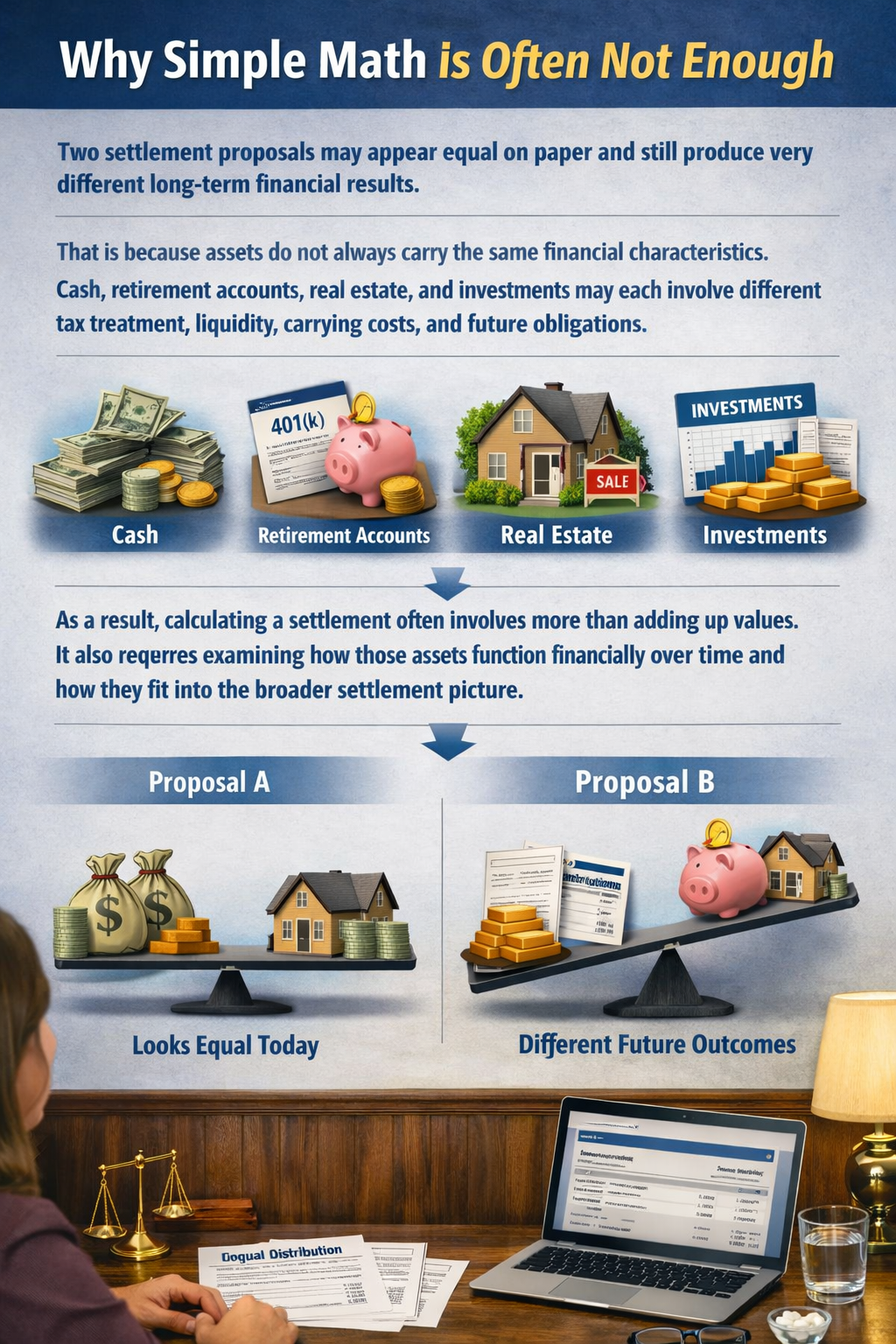
Two settlement proposals may appear equal on paper and still produce very different long-term financial results.
That is because assets do not always carry the same financial characteristics, and those characteristics can change differently for different assets over time. Cash, retirement accounts, real estate, and investments may each involve different tax treatment, liquidity, carrying costs, and future obligations.
As a result, calculating a settlement often involves more than adding up values. It also requires examining how those assets function financially over time and how they fit into the broader settlement picture.
For example, one proposal might involve receiving $100,000 in retirement funds, while another offers $100,000 in cash. While the values appear equal, taxes, future value and access to funds may make the outcomes very different.
The Financial Factors That Can Change the Outcome
Several financial elements can significantly affect whether a proposed settlement works well in practice.
Asset Type
Not all assets are equally useful, accessible, or flexible. The type of asset received can matter as much as the stated value.
Debt Allocation
Who assumes particular debts can strongly affect future cash flow, refinancing options, and borrowing capacity.
Tax Consequences
Some assets may carry future tax obligations that change their real financial value.
Liquidity
Receiving value in illiquid assets may create a different financial reality than receiving cash or easily accessible funds.
Future Costs
Assets like a home may also involve ongoing expenses that continue long after the settlement is complete.
Why Comparing Different Settlement Options Matters
One proposed settlement may seem reasonable in the moment, but without comparing alternatives it can be difficult to understand whether it truly supports your longer-term financial position or not.
For example, one scenario may involve keeping the family home while another may involve selling it and retaining greater liquidity. One proposal may shift more debt to one spouse, while another balances assets differently but changes future obligations.
Comparing these possibilities can help reveal trade-offs, risks, and opportunities that might otherwise remain hidden.
A proposal that appears fair at first glance may look very different once taxes, debt obligations, and future costs are taken into account.
What to Look for in a Divorce Settlement Calculator
When evaluating a divorce settlement calculator or analysis tool, it can be helpful to look beyond whether it simply produces a number.
A more useful tool should help organize financial information, compare different settlement structures, and bring important financial considerations into view before decisions are finalized. A tool that only produces a single number may not provide enough insight to support meaningful decisions.
It should also make it easier to update values, test alternative allocations, and evaluate the practical implications of proposed outcomes as negotiations change over time.
How DivorceSplit Helps You Evaluate Settlement Options
DivorceSplit was created to help individuals analyze settlement scenarios and compare how different proposals may affect their financial position.
By organizing financial information and allowing users to model different allocations of assets and debts, DivorceSplit helps bring financial consequences into view before agreements are finalized.
Users can update values, evaluate changing proposals, and compare how different arrangements may affect net worth, debt obligations, and overall financial outcomes.
Rather than relying only on assumptions or rough estimates, scenario analysis can help individuals approach settlement decisions with greater clarity and confidence.
If you are also weighing emotionally significant assets, you may find it helpful to read our guide on whether to keep the house in a divorce. You can also explore our article on financial mistakes to avoid in divorce settlements.

Moving Forward With Greater Clarity
Searching for a divorce settlement calculator is often the beginning of a larger effort to understand what different settlement options may actually mean financially.
Because divorce settlements involve more than simple math, taking the time to compare multiple scenarios and evaluate the broader financial consequences can be an important step before making decisions.
Understanding these possibilities more clearly can help individuals approach settlement discussions with greater confidence and a better sense of what different outcomes may mean going forward.